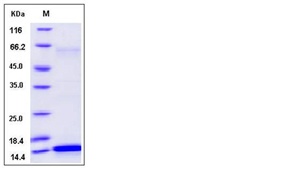
Interleukin-2, also known as a T-cell
growth factor, TCGF, and IL2, is a secreted protein that belongs to the
IL-2 family. Interleukin-2 / IL-2 was the first interleukin molecule to
be discovered. Interleukin-2 / IL-2 molecule was first purified to
homogeneity by immunoaffinity chromatography by Kendall Smith and his
team at Dartmouth Medical School. Interleukin-2 / IL-2 was also the
first cytokine shown to mediate its effects via a specific IL-2
receptor, and it was also the first interleukin to be cloned and
expressed from a complementary DNA (cDNA) library. Interleukin-2 / IL-2
was designated number 2 because Smith's data at the time indicated that
IL-1, produced by macrophages, facilitates IL-2 production by T
lymphocytes (T cells).
Interleukin-2 / IL-2 is produced by T-cells in response to antigenic or
mitogenic stimulation, this protein is required for T-cell proliferation
and other activities crucial to regulation of the immune response.
Interleukin-2 / IL-2 is normally produced by the body during an immune
response. When environmental substances (molecules or microbes) gain
access to the body, these substances (termed antigens) are recognized as
foreign by antigen receptors that are expressed on the surface of
lymphocytes. Antigen binding to the T cell receptor (TCR) stimulates the
secretion of Interleukin-2 / IL-2 and the expression of IL-2 receptors
IL-2R. The IL-2 / IL-2R interaction then stimulates the growth,
differentiation, and survival of antigen-selected cytotoxic T cells via
the activation of the expression of specific genes. Interleukin-2 / IL-2
can stimulate B-cells, monocytes, lymphokine-activated killer cells,
natural killer cells, and glioma cells. The World Reference Standard for
Interleukin-2 / IL-2 is produced by the National Institute of
Biological Standards and Control in the UK. A recombinant form of
Interleukin-2 / IL-2 for clinical use is manufactured by Chiron
Corporation. It has been approved by the Food and Drug Administration
(FDA) for the treatment of cancers (malignant melanoma, renal cell
cancer), and is in clinical trials for the treatment of chronic viral
infections, and as a booster (adjuvant) for vaccines. The use of
Interleukin-2 / IL-2 in HIV therapy is ineffective.
参考文献
Smith KA, et al.,1980, J. Exp. Med.151 (6): 1551-6.
Smith KA, et al.,1980, Nature. 287 (5785): 853-5.
Taniguchi T, et al.,1983, Nature. 302 (5906): 305.
Cantrell DA, et al.,1984, Science. 224 (4655): 1312-6.
Smith KA, et al.,1988, Science. 240 (4856): 1169-76.
Wang X. et al., 2005, Science 310:1159-63.
Stauber D.J. et al., 2006, Proc. Natl. Acad. Sci. USA. 103: 2788-93.